Flyers vs Leaflets vs Posters: Which Print Format Works Best?
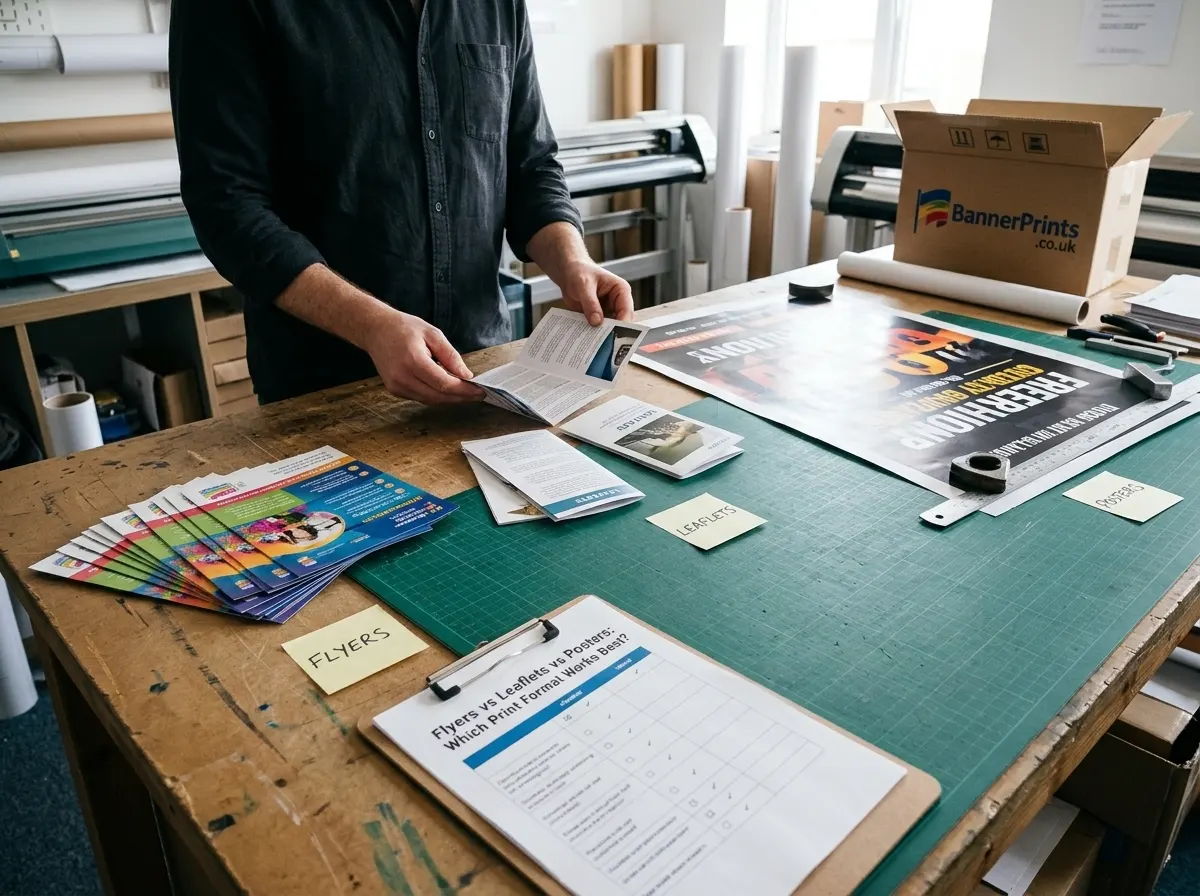
Flyers, leaflets, and posters are three of the most effective print marketing formats, but they serve different purposes and work best in different situations. Choosing the wrong one means your message gets ignored or fails to reach the right audience in the right way.
This guide explains exactly what each format is, how they differ, and which one to choose based on your goals, your budget, and how you plan to distribute them.
What Is a Flyer?
A flyer is a single-sheet, single-sided or double-sided printed piece, typically A5 or A6 in size. Flyers are designed for mass distribution. They are handed out on the street, placed on countertops, tucked into bags at events, or posted through letterboxes. The purpose of a flyer is to deliver one clear message quickly: an event, a promotion, a new business, or a special offer.
Flyers work best when the message is simple, and the call to action is immediate. They are not designed to carry detailed information. Instead, they grab attention, deliver the key point, and prompt the reader to take the next step, whether that is visiting a website, calling a phone number, or attending an event.
Best Uses for Flyers
- Promoting events, gigs, and club nights
- Announcing sales, discounts, and special offers
- Advertising new business openings
- Political and community campaigning
- Takeaway menus and food delivery promotions
What Is a Leaflet?
A leaflet is a multi-panel printed piece, usually created by folding a single sheet of A4 paper into two (bi-fold), three (tri-fold), or four (quad-fold) panels. Leaflets carry more information than flyers and are designed to be read in sequence as the reader unfolds each panel.
Leaflets work best when you need to tell a more complete story. They are ideal for explaining services, listing features and benefits, presenting a product range, or providing information that requires more space than a single flyer allows.
Best Uses for Leaflets
- Service overviews for tradespeople, consultants, and agencies
- Product catalogues and price lists
- Tourist information and local guides
- Health and safety information sheets
- Charity and fundraising appeals
- Property details and estate agent marketing
What Is a Poster?
A poster is a large-format single-sided print designed to be displayed on walls, windows, notice boards, and public spaces. Standard poster sizes range from A3 to A0, with A2 being the most common choice for most applications. Posters are designed to be seen from a distance and to communicate visually rather than through dense text.
Posters rely heavily on eye-catching design, bold imagery, and minimal text to stop people in their tracks. They are the most passive of the three formats, meaning people encounter them in passing rather than being handed one or having one posted through their door.
Best Uses for Posters
- Shop window promotions and sale announcements
- Event advertising in public spaces
- In-store product promotions and point-of-sale displays
- Community notice boards and public information
- University and college campus advertising
- Film, music, and cultural event promotion
Key Differences at a Glance
Size: Flyers are small (A5/A6). Leaflets are A4 folded. Posters are large (A3 to A0).
Sides: Flyers are single or double sided. Leaflets are multi-panel. Posters are single sided.
Information depth: Flyers carry one message. Leaflets carry detailed information. Posters carry a visual message with minimal text.
Distribution: Flyers are handed out or posted. Leaflets are displayed in racks, handed out, or mailed. Posters are displayed on walls and boards.
Purpose: Flyers prompt immediate action. Leaflets inform and educate. Posters create awareness and visibility.
Cost per unit: Flyers are the cheapest. Leaflets cost slightly more due to folding. Posters cost more due to larger paper size.
When to Choose a Flyer
Choose a flyer when you need to reach a large number of people quickly with a single, clear message. Flyers are the most cost-effective option for mass distribution and work best for time-sensitive promotions where the goal is to drive immediate action.
If your message can be boiled down to a headline, a few bullet points, an image, and a call to action, a flyer is all you need.
When to Choose a Leaflet
Choose a leaflet when your message needs more space and structure. If you are introducing your business, explaining a range of services, or providing information that the reader will want to keep and refer back to, a leaflet gives you the room to do it properly.
Leaflets are also the better choice for B2B marketing, where decision-makers need enough detail to evaluate your offer before getting in touch.
When to Choose a Poster
Choose a poster when your goal is visibility and brand awareness in a physical space. Posters work best in high-footfall locations where people pass by regularly: shop windows, community boards, campus corridors, and public buildings.
If your message is simple enough to communicate with a strong image, a headline, and a website address, a poster will do the job more effectively than a flyer or leaflet in a display setting.
Can You Use All Three Together?
Yes, and this is often the most effective approach for a marketing campaign. A well-planned print campaign might use posters to build awareness in high-traffic locations, flyers for mass distribution in the local area, and leaflets as a detailed follow-up for people who express interest.
For example, a new restaurant opening might put up A2 posters in nearby shop windows, hand out A5 flyers at the local train station with a discount code, and leave tri-fold leaflets on the counter with the full menu and contact details. Each format plays a different role in the same campaign.
Paper Stock and Finishing Options
The paper you choose affects how your print looks and feels. Here are the most common options:
- 170gsm gloss or silk: The standard for flyers. Smooth, professional, and cost-effective for bulk printing.
- 250gsm gloss or silk: A thicker, more premium stock suitable for leaflets and high-quality flyers that need to feel substantial.
- 350gsm gloss or silk: A card-weight stock used for premium leaflets, postcards, and flyers that need extra durability.
- 120gsm uncoated: A lighter, natural-feel stock suitable for eco-friendly leaflets and text-heavy information sheets.
Finishing options like matt lamination, gloss lamination, and spot UV can add a premium feel and extra durability to any format.