Banner Ideas for Small Businesses 2026: Designs That Bring Customers In
Most people walking past your business will give it about three seconds. In that time, they decide whether you are open, what you sell and whether it is worth stepping inside. A good banner answers all three before they have finished the glance. A bad one gets ignored along with the rest of the street.
For small businesses, that makes banners one of the best-value marketing tools going. You pay once, and the banner works every hour you are open, and every hour you are not. Below are 20 practical banner ideas, grouped by where they work best, plus the sizing, material and design rules that decide whether they actually bring people through the door.
The best banner ideas for small businesses are the simplest: a “Now Open” or single-offer banner outside the shop, a roller or pop-up banner for events, feather flags for forecourts, and seasonal banners that refresh the shopfront. Keep each banner to one message, use high-contrast colours, and size the text so it can be read from where your customers actually stand.
What Makes a Banner Work for a Small Business?
Before the ideas, the rules. Almost every underperforming banner breaks one of these, and fixing it costs nothing.
| Element | What works | What to avoid |
| Message | One idea per banner | Listing every service you offer |
| Headline | Five words or fewer | Full sentences and slogans |
| Colour | Two brand colours with strong contrast | Light text on busy photos |
| Call to action | One clear next step | Phone, email, website and socials all at once |
| Text size | Sized for the real viewing distance | Small print that only works up close |
A useful signmaker’s rule of thumb is around 25mm of letter height for every 3 metres of viewing distance. If drivers need to read your banner from 15 metres away, your main headline needs letters of at least 125mm, and bigger is better.
Which Banner Ideas Work Best Outside a Shop?
Outdoor banners are your first impression. They need to work at a distance, in poor light and in the weather.
- The “Now Open” banner
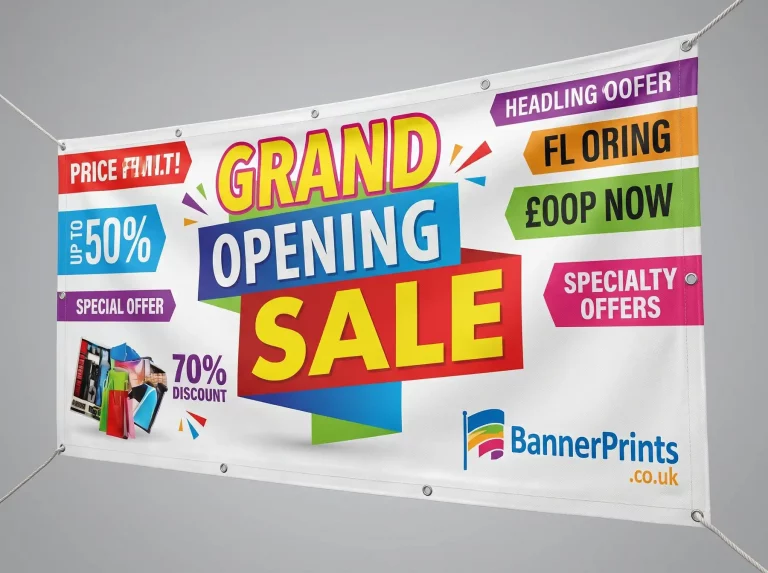
Simple, direct and still one of the most effective banners there is. Use it for a launch, a reopening after a refit, or a new unit that people have not noticed yet. Two words, your logo and your brand colour are enough. - The single-offer sale banner
Pick one offer, such as “20% Off This Weekend”, and make it the whole banner. The moment you add a second offer, both get weaker. - The directional arrow banner
If your entrance is round the side, up a floor or tucked into a courtyard, a banner with a large arrow and “This Way” can do more for footfall than any advert. - The “what we do” banner
Ideal for businesses whose shopfront does not explain itself. Three short service words, such as “Repairs, Servicing, MOTs”, tell passers-by exactly why to stop. - The product photo banner
For cafés, bakeries and retailers, one large, sharp photo of your best product often sells harder than any words. Keep the text to a single line underneath. - The review banner
A short customer quote or your star rating builds trust with people who have never tried you. Keep it genuine and keep it brief. - The QR code offer banner
Add a QR code linking to a menu, booking page or offer. Make the code large, place it at eye level, and tell people what they get for scanning it. - Feather flags on the forecourt
For car washes, garages, garden centres and anything with a forecourt, feather flags catch the eye of passing drivers in a way a flat banner cannot. Their movement is the point.
What Banner Ideas Suit Events, Markets and Exhibitions?
At an event, you are competing with every other stand in the room. Your banner has to explain who you are before a visitor reaches your table.
- The one-message roller banner
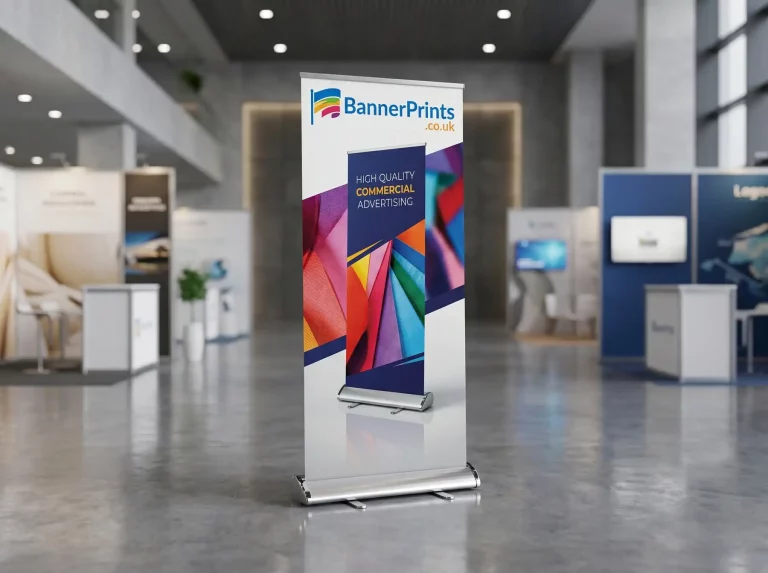
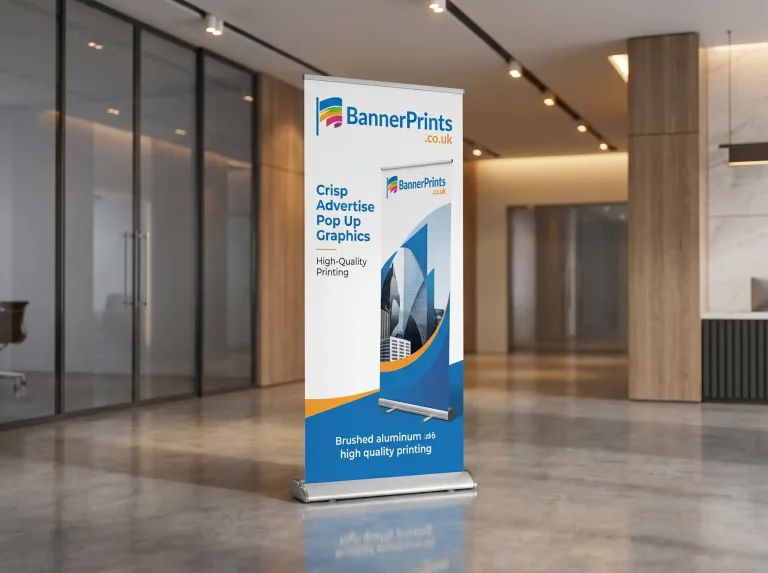
A roller banner works best with a single headline at the top, one strong image in the middle and your logo and web address at the bottom. The top third is what people see over the heads of a crowd, so put your most important words there. - The pop up banner wall
Pop up advertising banners turn a bare exhibition space into a fully branded stand. Because the graphic is wide, it works as a backdrop rather than a sign, which makes your stand look established even if you are exhibiting for the first time.
How do you design a pop-up banner?
Design the pop up banner as one continuous image across the panels, with your logo and headline in the top half where they stay visible above the table. Keep key text away from the curved end panels, which wrap around the frame, and avoid placing anything important in the bottom 800mm, which is usually hidden behind furniture.
- The market stall menu banner
For street food and market traders, a banner listing three to five items with prices speeds up queues and helps people decide before they reach you. - The branded photo backdrop
A repeat-logo backdrop gives visitors a reason to take photos at your stand, and every photo shared carries your branding further than the event itself. - Teardrop flags at the entrance
Teardrop flags hold their shape and keep your logo readable, which makes them ideal for marking your stall, a shop entrance or the start of a trail.
How Can Trades and Service Businesses Use Banners?
You do not need a shopfront to get value from banners. Every job site is a free advertising space.
- The site banner
A banner on the fencing of a live job, such as “Another Project by [Your Company]” with your phone number, turns every neighbour and passer-by into a potential lead. - The scaffold mesh banner
Builders, roofers and renderers can use mesh banners on scaffolding for weeks at a time. Mesh lets the wind through, so it stays secure where a solid banner would strain the structure. - The recruitment banner
“We’re Hiring” with a phone number or QR code is a cheap and surprisingly effective way to find local staff, especially for trades and hospitality.
What Seasonal Banner Ideas Keep a Shop Looking Fresh?
A banner that never changes becomes invisible to regular passers-by. Swapping in a seasonal design a few times a year tells people you are active and gives them a new reason to look.
| Idea | Season | Message angle |
| 17. Christmas banner | November to December | Gift offers, late opening hours, booking reminders |
| 18. Summer banner | June to August | Outdoor seating, cold drinks, holiday hours |
| 19. Back to school banner | August to September | Uniforms, stationery, tutoring, lunch deals |
| 20. Anniversary banner | Any time | “10 Years in [Town]” builds local loyalty |
Keep your main shopfront banner permanent and treat seasonal banners as a second layer. That way your core branding stays consistent while the offer changes.
Which Banner Material Should a Small Business Choose?
The right material depends on where the banner lives and how long it needs to last.
| Material or format | Best for | Why |
| PVC vinyl banner | Shopfronts, fences, general outdoor use | Weatherproof, durable, strongest colour |
| Mesh banner | Scaffolding, heras fencing, exposed sites | Lets wind through, reduces strain |
| Fabric banner | Indoor displays, premium events | Rich colour, no glare, folds without creasing |
| Roller banner | Events, receptions, pop-up shops | Portable, sets up in seconds |
| Pop-up banner | Exhibitions and trade shows | Full branded backdrop for a stand |
| Feather and teardrop flags | Forecourts, entrances, events | Movement and height attract attention |
How Big Should a Small Business Banner Be?
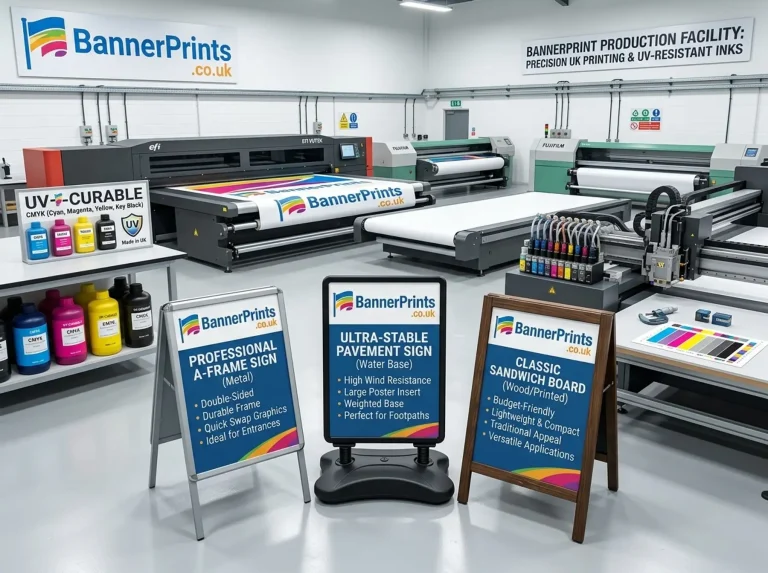
Size follows viewing distance, not budget. The 8ft x 3ft and 6ft x 2ft formats are the most popular choices for shopfronts and events because they fit most frontages and railings while still carrying readable text from across the street.
Before ordering, stand where your customers will be, whether that is the opposite pavement, the car park or the end of an exhibition aisle, and measure the space available. Check for obstacles such as trees, lamp posts and parked vans. A banner that is half hidden is wasted.
How Do You Know If Your Banner Is Working?
Give each banner a way to be measured. Put a unique offer on it, such as a code word to mention at the till, or a QR code that only appears on that banner. Count how many people use it over a month.
If results are flat, change one thing at a time: the headline, the placement or the offer. Swapping everything at once makes it impossible to know what made the difference.