Indoor vs Outdoor Banners: Key Differences Explained
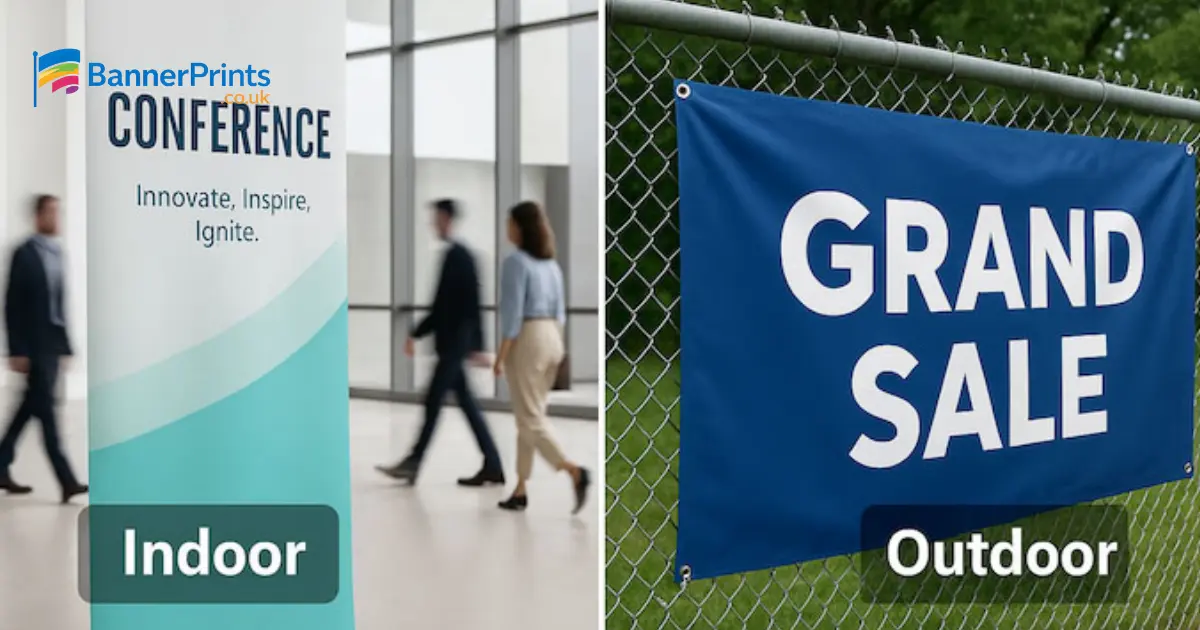
Indoor vs outdoor banners explained. Learn the key differences in materials, durability, print quality, and when to use vinyl or mesh banners.
Banners are still a useful visual tool of marketing to a business and one mistake that most businesses make is using the wrong banner in the wrong environment which is costly. Most banners are so eye-catching on the first day, but they wear out, get torn, or become ineffective due to the inadequate design used.
In Bannerprints.co.uk, we are often called upon to assist UK companies with placing an order on banners, be it indoor or outdoor banners. Although their appearance might be quite alike, the materials, printing techniques and finishing choices are quite divergent. In this manual, we describe the main variations between indoor and outdoor banners, therefore, being able to select the appropriate solution to your place and use.
What Is an Indoor Banner?
Indoor banners are constructed in controlled conditions where the banners are not subject to weather and other conditions like rain, wind and direct sunlight. These banners are more about visual clarity and the design detail and not about enormous durability.
The indoor banners are popular in:
- Retail stores
- Shopping centres
- Reception areas
- Exhibitions and trade shows
- Offices and showrooms
Since indoor settings are rigid, such banners can be made of smoother materials and finer details and print without heavy reinforcement.
What Is an Outdoor Banner?
The outdoor banners are constructed to withstand the weather condition in the UK such as wind, rain, and long exposure of sunlight. The first needs are durability and safety.
Banners which are placed outdoors are commonly used to advertise:
- Shopfront advertising
- Construction sites
- Fencing and scaffolding
- Events and festivals
- Promotions on the roadside and pavement.
Such banners demand tougher shapes and inks with weather-resistance durability that have reinforcement of the final finish to maintain a long-term performance.
Distributional Differences: Outdoor vs. Indoor Banners
Indoor Banner Materials
The most frequently used banners that are printed on the indoor setting are made of vinyl (PVC) which is a smooth material. This allows for:
- Sharp text and graphics
- Vibrant colours
- Lightweight handling
The lack of wind resistance in an indoor setting means an indoor setting does not require the banners to have holes or heavy reinforcement.
Outdoor Banner Materials
- Outdoor banners normally employ:
- Durable outdoor vinyl sheltered.
- Banners with holes to be used in windy or exposed areas.
Mesh banners have small holes that permit free air flow and this eliminates strain on fixings and damages in windy seasons.
Ink Technology and Quality of the print
Banners in the interior environment emphasise on the high-resolution printing as people are usually in closer contact with the display. The small text, fine details, and gradients are more readable in an indoor environment.
Outdoor banners are printed with UV-resistant colors which do not fade under the sunlight. Print quality is high although outdoor designs may include:
- Bolder fonts
- Higher contrast colours
- Simpler layouts
This provides long distance and long life readability.
Wear and Tear and Weather-proofing
The duration of the outdoor and indoor banners is among the biggest contrasts as far as the lifespan of the banners in their respective locations is concerned.
Indoor banners:
- Or are covered over with wind and rain.
- Prolong the durability of least wear.
- Require less maintenance
- Indoor Banner Finishing
- Outdoor banners are frequently topped off with:
- Smooth edges
- Lightweight eyelets
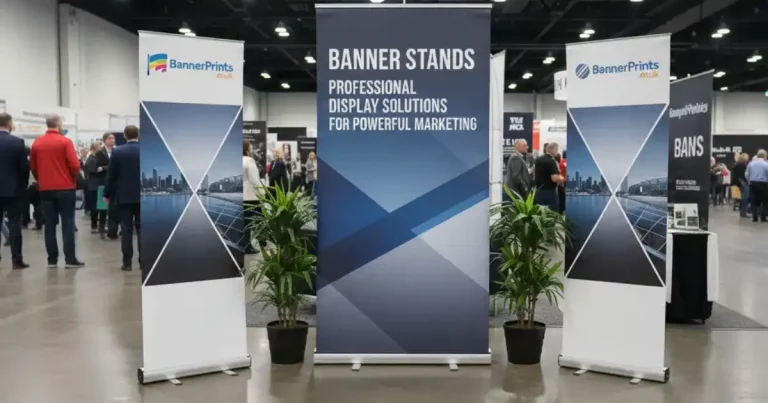
- Banner stands or wall mounts
- They can be set up and relocated easily.
Outdoor banners:
- Should not be able to withstand moisture and UV.
- Should be made of stronger materials and finishing.
- Either designed to be used temporarily or on a long-term basis in the outdoors.
- When an indoor banner is selected to use outdoors, tearing, fading, or safety may occur.
- Method of Finishing and Repairing.
Outdoor Banner Finishing
Outdoor banners must be reinforced, which includes:
- Strong hems
- Metal eyelets
- Tension systems or pole pockets.
These are useful in making banners remain safe in case of wind and weather, particularly on the open grounds.
Safety Considerations
Outdoor banners are most concerned with safety. In windy place solid banners may serve as sails, straining attachments and other structures.
The reason why mesh banners are highly recommended is because they are recommended in:
- Scaffolding
- Fencing
- Open outdoor spaces
These risks are not relevant to indoor banners, and the safety requirements are not so high.
Visual Design Differences
The indoor banners usually include:
- Detailed graphics
- Smaller text
- Softer colour tones
- Outdoor banners rely on:
- Large, bold text
Introduction of high contrast colour scheme
Simple messaging
When you design keeping in the viewing distance, then you are bound to be sure that your message will be understood in any environment.
- Cost The difference between an indoor and outdoor banner.
- The reason is that indoor banners are usually cheaper as:
- They use lighter materials
- Require less finishing
No need of weather-proof inks
Outdoor banners might be a little expensive initially, but due to their durability it is cost efficient in the long term especially where the campaign is long term.
What Banner to you, shall you Select?
Choose an indoor banner if:
- The banner will stay inside
- You need high visual detail
- There is no worry about wind and weather.
- Choose an outdoor banner if:
- The banner will be subjected to weather.
- Wind resistance is required
- Durability is an issue of long-term.
- Professional counsel can save you big bucks in case you are in doubt.
- Top Blunders of the businesses.
Bizwise, as we have learned at Bannerprints.co.uk, the most apparent errors are:
Outdoor banners used indoors
- Ignoring wind exposure
- Selecting an inappropriate banner material.
- Overloading the outdoor designs with small text.
- It is better to avoid these problems to save time, money, and frustration.
- The Importance of Professional Banner printing.
Banner printing done by a professional is good enough to guarantee:
Correct material selection
- Proper file setup
- The reproduction of accurate colour.
- Quality delivery and repairs.
A UK based printer also implies a quicker turnaround and control of quality.
FAQs: Indoor vs Outdoor Banners
Final Thoughts
Banners that are placed indoors and those that are placed outdoors may resemble each other, yet they are used with totally different intentions. The correct decision will be based on environmental, exposure, longevity, and design requirements. These differences can be understood to enable businesses achieve improved outcomes and secure investment.
We feel that in Bannerprints, banners must do as good as they should be. Banners used in the interior environment may be crisp, indoor vinyl or in the outdoor environment, they may be strong and durable, in the form of mesh banners.