Common Banner Printing Terms Explained in Simple Words: Guide
Learn common banner printing terms explained in simple words, including bleed, CMYK, DPI, vinyl and mesh banners, and finishing options.
Banner printing terminology may be baffling and technical when you are ordering a banner the first time. Other terms such as bleed, CMYK, DPI or finishing are commonly used by printers but hardly explained in simple language. These names may be misinterpreted that results in bad print job, time waste or even needless reprinting.
Customers at Bannerprints.co.uk ought to know what they are ordering. This guide defines the most widely used banner printing terminologies using the simplest vocabulary that can assist you make definite decisions when printing the vinyl banners, mesh banners, and other big-format signage.
Common Banner Printing Terms
Binding
Binding refers to the process of attaching printed pages by using glue, wire or a sewing machine. The process has an influence on life cycle, aesthetics and ease at which the product opens and lives.
Bleed
The additional printed material that is outside the final size is known as bleed. It prevents the undesired white edges in case there is a shift in cutting during production.
Bundling
Bundling refers to the process of combining printed materials into packages so as to make the handling, storage and delivery easier. It is useful in ensuring that the prints are well organised and well protected during transit.
Capitalisation
Capitalisation is the usage of capital letters. Capitals are practical in headings and emphasis but must be used sparingly because excessive use will make the text less readable in the long-run.
Cellophaning
Cellophaning provides a thin protective layer of printed materials. It increases the durability, it is resistant to moisture, and with matte, gloss or textured finish.
CMYK
CMYK is an acronym of Cyan, Magenta, Yellow and Black. It is the conventional colour system used to print, which provides consistency and reliability of reproducing colours on hard copy.
Coated Art Paper
Art paper covered is smooth in nature and results in sharp images and vivid colours. It is normally preferred in brochures, posters, and quality promotional banners.
Coated Paper
Coated paper has a treated surface thus, the colours are brighter and the detail is sharper than when it is on uncoated paper.
Collating
The collating involves organization of the printed pages in the right sequence before binding. Effective collation will be used to have pages in order in brochures, booklets, and manuals.
Corporate Design
Corporate design comprises of the logo of a company, colours, fonts and style of a company. Regular application enhances brand awareness on banners, business cards and marketing resources.
Corporate Identity
Corporate identity is a personality, values and behaviour of a company. It incorporates design, tone of communication, and customer interaction of the brand.
Creaser
A creaser cuts a line with accurate precision into paper and folds. It does not crack on thick paper and folds clean and professional on banners and brochures.
DIN Formats
DIN is an A4 and A5 standard paper size. They assist in compatibility to the printing, storage and global document handling.
DPI
The dots per inch is abbreviated DPI and is used to determine image resolution. To achieve clarity in printing, one should have images of a minimum of 300 DPI to prevent blurriness or pixelation.
Embossing
Embossing involves etching designs up or down on paper. It gives business cards, packages, and high-quality print media texture, luxurious and visual effects.
Euroscale
Euroscale is a Color standard of CMYK printing. It maintains uniformity of color output among various printers as well as print batches.
Feeder Marks
Navigators are used to place the paper in printing machines in the right straight way. They counter colour misalignment and provide accuracy on the double-sided printing.
Final Format
Final format refers to the size of a printed item when it is trimmed. In order to get precise results, designers need to take bleed and cutting into consideration.
Finishing
The final step involves lamination, varnishing, embossing and foil stamping. These improve the longevity, looks and perceived quality of printed materials.
Fold
A fold refers to a ribbed paper to form brochures or leaflets. The styles of fold influence the layout, usability and presentation of information.
Fold Marks
Markings made on the paper direct the machines on where the paper is folded. They maintain accuracy in finishing and eliminate errors of alignment.
Format
The width and height of a printed product are called format. It has influence in design layout, printing costs and finishing options.
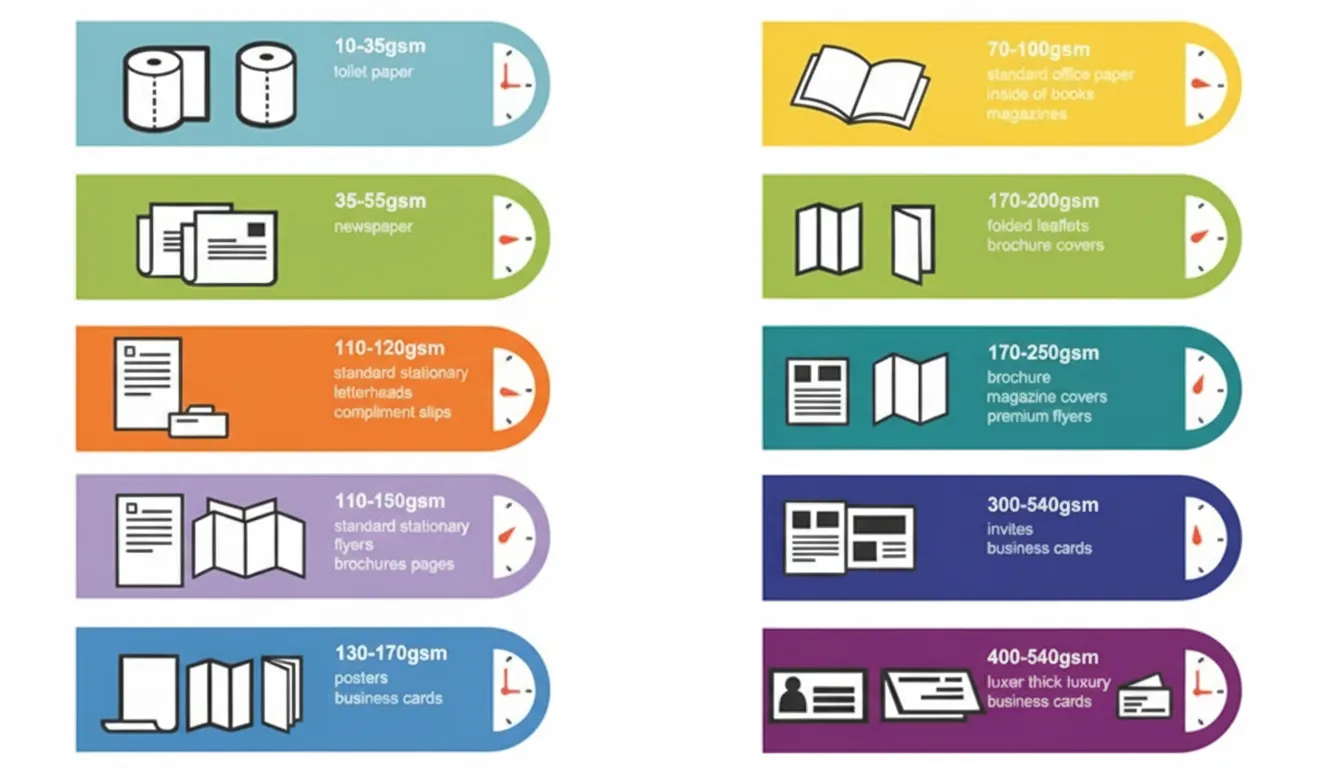
Grammage
Grammage is a paper weight that is measured in grams per square metre. A heavier grammage will be heavier and will be good in banners and business card.
Grip Margin
The unprintable space that the machines are gripping is known as the grip margin. Text or graphics should not be put in such an area by designers.
HKS
HKS is a European spot colour system that is applied in accurate colour matching. It is known to have a uniform brand colour through print materials.
JPEG
JPEG is a compressed picture format that is appropriate in photos. In printing, JPEG files should be of high quality and therefore should be of high resolution.
Layout
The arrangement of text, images and space is known as layout. Having a good layout enhances readability and gives viewers good focus.
Leporello Fold
A leporello fold consists of a zigzag or accordion pattern. It works best with banners, menus and guides that require a constant information flow.
Macrotypography
Macrotypography is about the general structure of the text, e.g. columns and spacing. It aids in bringing order in the content and enhances reading.
Microtypography
Microtypography is concerned with minor aspects such as the spacing between letters and the height of the lines. It makes printed work more readable and gives printed materials a professional appearance.
Opacity
Opacity is used to gauge the amount of ink that passes through paper. In case of a two-sided print a great text is not available because of high opacities.
Pantone
Pantone is a global spot colour system. It provides perfect colour matching particularly when it comes to logos and branded banners.
Perforation
Perforation involves the formation of tiny holes to make it easy to tear. It is mostly applied in vouchers, tickets, and detachable sections.
Print Run
The number of copies produced is called print run. Increased print volume is cheaper per unit, but must be well planned.
Proof
One of the indications is a sample of the final print. It assists in verifying colours, layout, as well as errors prior to complete production.
Vector Graphics
Plots are mathematical paths of a vector graphics. This allows them to go indefinitely without looking bad and is best used as logos and banners.
UV Varnish
UV varnish is a coating that ensures protection and gives a shine and is fast-curing. It makes it more durable and has a visual eye appeal.
WYSIWYG Editor
WYSIWYG editors display designs as it will be when printed. They make it easier to create layout, and minimize design errors.
FAQs of Common Banner Printing Terms
Final Thoughts
Understanding common banner printing terms empowers you to communicate clearly with printers, avoid costly mistakes, and achieve professional results with confidence.
When you know the basics, every banner decision becomes easier, smarter, and more effective for your business marketing goals.