Business Cards for Beginners: What Really Matters in Printing
Business cards for beginners explained clearly. Learn design tips, paper quality, printing basics, and common mistakes to avoid in the UK.
Business cards can be a minor consideration in branding, especially to newcomers, however, in practice, it can be a very physical introduction to your business. A shabbily printed card will be a blow to credibility, whereas a well produced, professionally printed card will convey the message of credibility in an instant. The number of choices of design and printing available is overwhelming when it comes to the first time of ordering business cards.
We are frequently dealing with start up, freelancers and small businesses in the UK that are having business cards printed at Bannerprints as the first time. In our experience, the most important thing is reduced to what can be read, good material, regularity in branding, and proper print preparation. This guide simplifies all this in simple terms so that even the beginners can make confident and informed decisions.
Why Business Cards Still Matter in a Digital World
Although digital networking has emerged, business cards are still considered as one of the surest means of offline marketing. They are fast to swap, simple to carry around and do not require batteries, applications, or the internet connection. Better said, they give you a physical reminder of your brand even after a conversation is over.
The business card is usually the first branded product that a beginner will create. That is why it is necessary to get the basics in place, as people tend to think of the quality of your business by the quality of your card.
Design & Content Essentials for Beginners
Design is not about decoration it is about communication. The primary purpose of a business card is to ensure that a person is able to remember you and the means of contacting you.
Prioritise Readability Above All Else
The major use of a business card is to exchange information. When somebody cannot read your information, the card has broken down–no matter how classy it may be.
We recommend:
- Clean, professional fonts
- Text minimum size of 8pt (10pt is more safe as regards contact details)
- Big opposition between text and background.
You should not use too much decorative fonts or even script fonts particularly in phone numbers and email address. The typography is clear so that you can read your card regardless of the light conditions.
Keep the Design Simple and Uncluttered
The most widespread beginner error that we encounter is the attempt to inscribe too much information on a small card. White space is not wasted space because it assists in bringing out key elements. A minimalism design usually appears:
- More professional
- Easier to read
- More memorable
Stick to the things that are necessary and provide space around text and logos.
Include Only Essential Information
- An easy to use business card must have:
- Your name and job title
- Company name and logo
- Phone number
- Email address
- Website (if applicable)
Social media handles, or a QR-code to your webpage or digital business card can be added as an option. QR codes are specifically effective with the contemporary business, yet they are to be used to supplement rather than to substitute basic contacts information.
Maintain Consistent Brand Identity
Your business card must have a visual correspondence to other marketing documents. Branding stability creates brand recognition and credibility.
Use:
- Your colour palette that is in place.
- Your official logo
- Brand-approved fonts
At Bannerprints, we have always recommended to the beginners that their business card is not an individual design, but it is a part of the bigger brand system.
Proofread Meticulously
One mistake can ruin you as a professional. We suggest that you should not only proofread your card several times but also have a colleague or a friend look at it. Pay close attention to:
- Email addresses
- Phone numbers
- Website URLs
Mistakes are expensive to correct after being printed.
Printing & Production: What Beginners Must Know
The finest design may fail miserably in front of a low quality printing. Knowing the fundamentals of print needs is one of the ways in which you can make sure that your cards look and feel professional.
Choose a Quality Paper Stock
The touch of your business card is more than you think beginners. The use of thin and wafery cards can render a business low-end or provisional.
- We recommend:
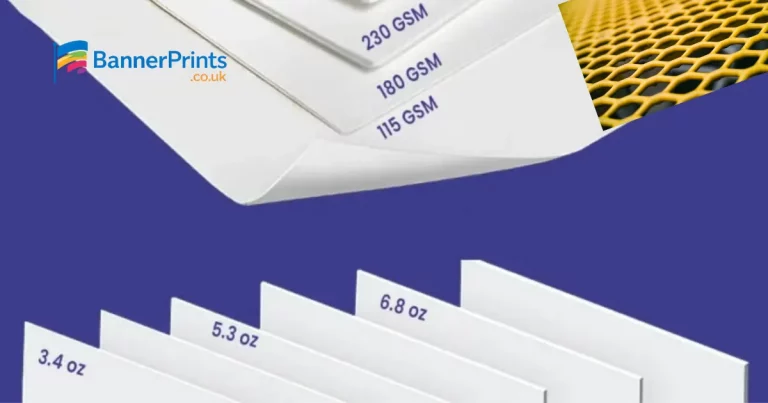
- 300-400gsm card stock
- Equivalent to 14-16pt thickness
This weight is very substantial, solid, and business-like-perfect to the majority of UK businesses.
Use the Correct Colour Mode (CMYK)
Design files are always configured to the CMYK color mode which is the standard in printing. The most novices draw in RGB (to display on screens) and this may lead to unpredictable colour change as it is printed.
- Using CMYK ensures:
- Greater reproduction of colours.
- Predictable print results
- Less production-related surprises.
Ensure High Resolution for Sharp Printing
The minimum number of dots per inch (DPI) should be 300. Images that are not high-resolution can look well on a screen display, but not on paper which is blurred or pixelated.
Logos are best in the form of a vector file because it can be resized without compromising on quality.
Understand Bleed and Safety Areas
It is necessary to set up files properly, in order to prevent white edges or cut-off content.
Bleed Area: Expand background colours/images by 3mm of the trim line. This avoids the occurrence of white cuts.
Safety Area: Always leave all important texts and logos at least 3-5mm inward of the card edge to prevent being trimmed off.
Such minute technicalities matter in the end outcome.
Consider Print Finishes Carefully
- Correctly used, special finishes can make your business card special.
- Popular options included
- Matte lamination: Glare free and smooth and modern.
- Gloss lamination: Intense colours and the added shine.
- Soft-touch matte: Luxurious and mostly high-end brands.
- Spot UV: Emphasizes the use of certain details such as logos.
- Embossing or foil stamping: Allows an addition of the luxury.
- Select finishes that support your brand personality and do not put effects on it as a decoration.
Common Beginner Mistakes to Avoid
Based on our experience with first-time customers, the following are the most frequent errors:
- Overcrowded designs
- Low-resolution images
- Incorrect colour mode
- Negligence on bleed and safety margins.
- Selecting paper which is too thin.
These problems are time, money and annoyance avoidable.
Why Printing with a Professional UK Printer Matters
By collaborating with a professional printer in the UK, it will be guaranteed that:
- Faster turnaround times
- Better quality control
- Since it is a good reproduction, it is accurate in colouring.
- Professional advice to inexperienced individuals.
We also use a step by step approach to customers at Bannerprints.co.uk by helping them with arranging their file and even choosing the material thus first time shoppers have no hesitation doing their first shopping.
FAQs : Business Cards for Beginners
Final Thoughts
To start off, printing of business cards does not necessarily have to be complex. The only thing that counts is the emphasis on the readability, good materials, the uniformity of branding, and proper file preparation. Business cards are great networking tools, brand building, and credibility-building tools when properly done.
We feel that a business card ought to be as professional as the business itself at Bannerprints. Knowing what is really important in printing, beginners are able to produce cards that make a memorable impression and allow throughout development.