Business Card Buying Guide: Paper Weight, Finish & Design
Learn how to choose the right business card buying guide covering paper weight (GSM), finishes, and professional design tips.
Business cards are still one of the strongest offline tools of building a brand, despite being in a digital-first world. A business card makes a powerful first impression when done and printed right, conveys a sense of professionalism and supports brand recognition within a few seconds. Nevertheless, several companies are not that much concerned about the weight of paper, finish and design and how these factors impact the perception of a card.
Remembering that buying guide is a buying guide that explains everything you need to know prior to ordering business cards so that you make informed decisions that portray your brand and industry.
Why Business Card Quality Still Matters
A business card is mostly exchanged in significant occasions like a meeting, networking or even during a first meeting. The tactile experience of a card has an impact on perception even before the reading is done. A good card inspires confidence and a shaky card may undermine credibility without the knowledge of the person to whom it is handed.
Business cards use the sense of touch unlike the digital contact sharing. The experience of your brand in terms of weight, texture, and finish is all part of making the brand memorable. That is why quality is not less important, and careful decisions count.
Understanding Business Card Paper Weight (GSM)
GSM is the abbreviation that means grams per square metre and it is the measure of thickness and density of paper. GSM has a direct and significant role in business card printing durability, stiffness, as well as perceived value. The greater the GSM, the more thick and premium the card is.
The correct GSM means that your card will retain its form, will not bend, and will be comfortable to use. The first thing that people usually get when receiving a business card is paper weight.
Common Paper Weights Used for Business Cards
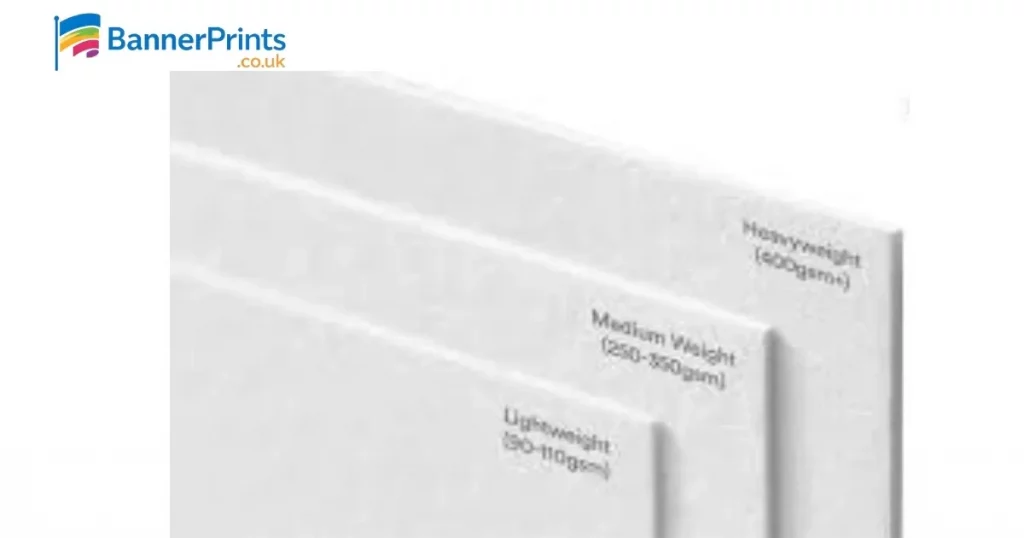
The majority of business cards are in the 250-450 GSM. Each weight group has a different purpose in terms of budget, branding and the frequency of use.
The low GSM cards are lighter and cheaper who the high GSM cards are durable and long lasting. The right range is determined by what you want your brand to be.
Which GSM Is Best for Your Business Cards?
In the case of most business professionals, 350 GSM is the perfect ratio between quality and cost. It is hard yet not too stiff and can be used with the majority of finishes.
You can have a premium or luxury feel which comes with an additional thickness and durability of 400-450 GSM. When it is needed in mass distribution or on a short-term basis, 250-300 GSM can be enough.
Single-Layer vs Multi-Layer Business Cards
Single-layered business cards are crafted out of a single sheet of card stock. They are affordable, flexible and applicable in most businesses. Such cards are simple to print and complete.
Multi-layer business cards are multi-layered cards where two or more sheets are used, usually with a coloured core. They are heavier and more unique and best suited to a brand that requires a high or creative differentiation.
Business Card Finishes Explained
The surface that is used to cover a business card is called finish. It influences the looks, feeling, and strength. The finish is a right finish that is used to improve design and wear resistant.
The most widely used finishes are matte, gloss, soft-touch and specialty finishes. With each finish, there is a varying visual and tactile experience and this will impact on how your card is received.
Matte vs Gloss Finish: Key Differences
The matte finishes provide an unreflective and professional feeling finish. They minimize glare and fingerprints that would cause difficulty in reading the text during bright light.
Gloss finishes are glamorous and bright and add colour and contrast. They are sight grabbing yet desirable to creative business ventures, albeit, prone to reflecting light and capturing fingerprints.
Soft-Touch and Premium Finish Options
Soft-touch finishes are velvety and luxurious and refined. High-end brands, consultants and high-end service provides are often using them.
The other high quality features are spot UV, foil stamping, and embossing. These types of finishing bring about visual appeal and textural value but are recommended to be used sparingly as they will not be easily perceived as a way of overdoing the design.
Laminated vs Unlaminated Business Cards
Lamination will provide a protective layer that will contribute to the durability and lifetime. The laminated cards are resistant to moisture and scratches as well as daily handling, and this makes them a good choice of cards to use.
Cards that are not laminated are more natural and paper like but can break easily. They can be used with eco-oriented brands or temporary campaigns when the texture is of greater importance than the duration.
Design Essentials for Professional Business Cards
Clarity, balance Good design places more emphasis on it. A business card must not be crammed and puzzling. The white space is used to direct the eye and make information more absorbable.
Pay attention to such important information as name, position, company name, phone, email and web-site. Further details can be posted online instead of crammed on the card.
Typography, Colour, and Brand Consistency
The fonts should be readable even in minor sizes. Simple and clean typography enhances readability and business. Do not use ornamental fonts which undermine readability.
The colours must match the brand and must have sufficient contrast to be easy to read. The use of a consistent brand in every piece of material helps to build recognition and trust.
One-Sided vs Double-Sided Business Cards
Single sided cards are easy and economical to use where there is minimal design required. These are effective when there is little information and there is a delicate branding.
Cards that consist of two sides give greater creativity. A lot of companies leave one side of the branded side and the other side as a contact side thus providing better layout and visual balance.
Final Checklist Before Ordering Business Cards
Check paper weight, finish, layout, and colour before printing. Make sure that files are configured in CMYK with bleed and safety margins.
Check a proof just in case spelling, aligning, or colour mistakes. One last glance will make sure that your business cards are included in your best brand.
FAQs
Final Thoughts
Business cards are not going away since they establish concrete and memorable contacts. Choosing paper carefully, finish and design, a card is a strong branding tool and not a contact detail.
Being aware of these main points, you can place an order on the business cards that will look professional, will last longer, and will make an impression even after a first handshake.