How Banner Printing Works: From Design to Delivery
Learn how banner printing works from design to delivery, including artwork setup, vinyl and mesh materials, finishing, and production.
When companies place banner orders, they invariably require three things, including rapid turnaround, quality print and a manufacturing partner that they can trust. Be it a vinyl banner or a mesh banner, knowing the way banner printing is done will make your decisions in a shopfront or in the outdoor ads easier and will also help you to prevent expensive errors.
We do the whole printing process of banners at Bannerprints, therefore we do the artwork drawing and delivery of the banners to the rest of the UK. It is an end-to-end method that will enable us control quality, meet strict deadlines and print all banners in professional standards. This is a backstage of the process of banner printing.
Step 1: Banner Design – Where Quality Begins
The process of great banner printing begins many years before the ink is put on the material. Design is an important factor in the appearance of your banner when printed in terms of seeing, reading and being professional. Our internal design department is geared towards print-ready art, rather than what appears attractive on the screen. It implies that we think well:
- The size of the fonts and the distance readability.
- Visibility in colour contrasting outdoor and indoor.
- Large-format art printing layout.
- Scalable graphics that are not pixelated.
In case you already have an artwork, we check and optimize it to be printed. Much of the files provided by novices require alterations like colour mode corrections, bleed or resolution. Our designers are always in close contact with production; hence, these fixes are fast and precise.
Step 2: Professional Printing File Set up
Correct file set up is one of the most neglected steps in the banner printing. A banner that has been well planned may not print right because of having a wrong technical arrangement.
We make sure that all banner files are of professional print such as:
- CMYK colour mode (not RGB)
- Large format graphics that are of high quality.
- Proper scaling of final size of banner.
- Bleed areas where required
This is to avoid problems like colour changes, poor images or unnecessary white strips following the trimming.
Step 3: Proofing – Before Production
A digital proof is always offered before printing starts. That will provide you with an opportunity to look at:
- Text and spelling
- Logo placement
- Colours and layout
- Banner size and orientation
The reason behind proofing is that banners are usually printed in big sizes. Even a small mistake could be very striking when the banner is in place. It is a step that saves the time and budget as it avoids reprints.
Step 4: Selecting the Material of Banners
- The choice of material is among the significant ones in banner printing. The materials needed in different environments are different.
- Vinyl Banners
- The most used is the vinyl banners. They offer:
- Sharp print quality
- Smooth surface
- Outdoor use in indoor and sheltered environment.
They are perfect with retail promotions, exhibitions, events, and short term outdoor displays.
Mesh Banners
Mesh banners are created to suit windy or open areas. The porous composition is porous to allow air to move into it so that the fixings are not strained.
They are commonly used for:
- Construction sites
- Scaffolding
- Fencing
- Outdoor |advertising in the open spaces.
The correct use of banner material will be safe, long lasting and have superior visual impacts.
Step 5: Large-Format printing technology
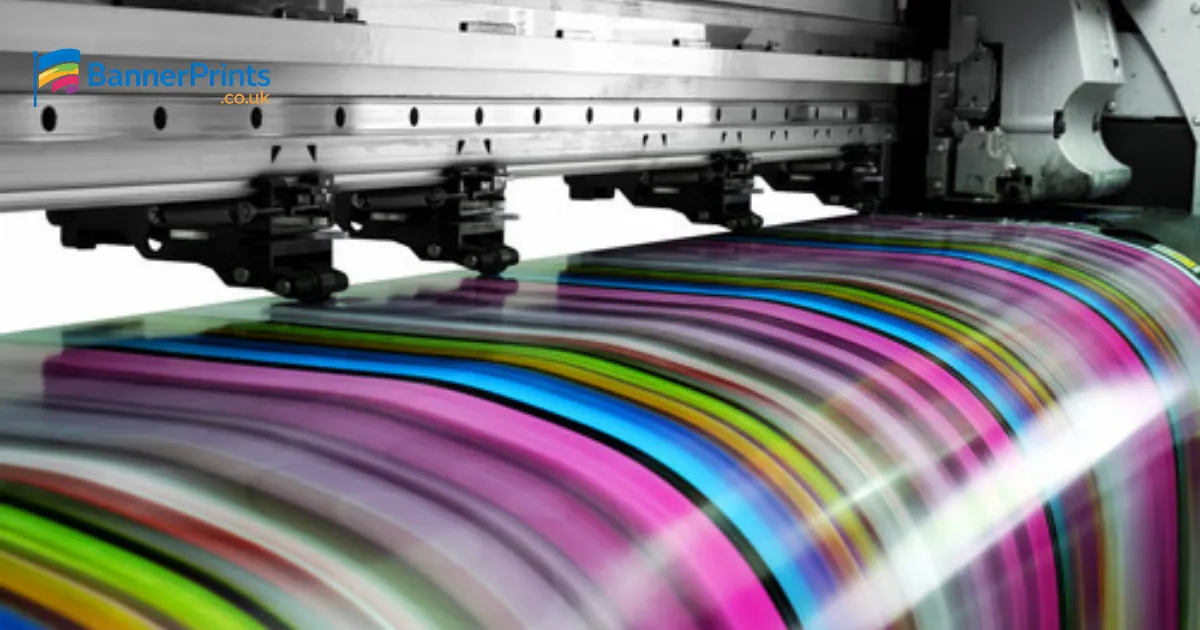
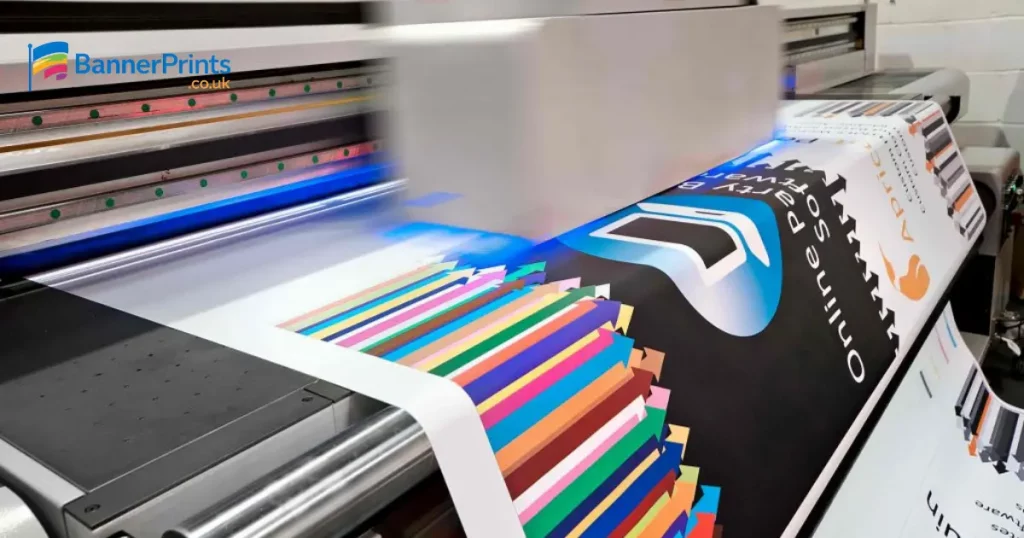
Upon approval of the design and the material, printing commences with large-format printers of the professional kind. These machines are used to work with wide banners with the same colour and detail.
We use:
- Outdoor inks are UV resistant.
- Crisp text and graphics with the use of high-resolution printing.
- Figure printers to ensure uniformity of colours.
This makes sure that your brand colours are identical in banners, business cards and other print materials.
Step 6: Finishing – When Banners Become Workable
It is finishing that will make a printed banner an effective marketing tool. Depending on the method of installation of the banner, we will add suitable finishing options like:
- Strengthened heels at the knees.
- Metal eyelets to be firmly fixed.
- Hanging systems have pole pockets.
The right finishing enhances the durability, particularly of outdoor banners, and facilitates the process of installation and is also safer.
Step 7: Before Dispatch Quality Checks
A last quality check is done to any banner before it leaves our facility. We inspect:
- Print clarity
- Colour accuracy
- Finishing strength
- Overall appearance
This last review serves to confirm that the banner is professionally satisfactory and can be used immediately on its delivery.
Step 8: Packaging and UK Delivery
Banners are packed in neat ways to avoid any damage during transportation. To ensure that banners are untouched, crease-less, and flat, we wrap them with protection and also the reinforced packaging.
Due to the in-house production, we will be able to provide quick delivery in the United Kingdom and consistent turnaround time, and express delivery on an urgent order.
Reasons why we should have In-House Banner Printing.
It has the obvious advantages of working on a printer that handles it all under a single roof:
- Faster turnaround times
- Better communication
- Consistent quality control
- Fewer errors and delays
In Bannerprints, we do not deal with several suppliers, or offshore manufacturing, at Bannerprints.co.uk, we have an integrated process. All of these actions are managed by a team which is aware of your project by the close.
Typical Printing Banner Blunders We Help You Elude
Our experience shows that the following are some of the problems that business may encounter:
- Using low-resolution images
- Selecting an inappropriate banner material.
- Disregarding the wind exposure of outdoor banners.
- Skipping proof checks
It is our business to steer you through these choices in order to get your banner to do exactly as you want it to do.
Who is the best person to use Professional Banner printing?
Banner printing is also best suited to professional banners:
- Retail stores
- Construction companies
- Event organisers
- Estate agents
- Exhibitions and trade shows
- Local business in the UK marketing services.
When properly done, banners are still one of the most economical ways of visual advertising.
FAQs : How Banner Printing Works
Final Thoughts
They are not banner printing, which is simply a matter of pushing the button of the printer. It is a process that needs design skills, proper file preparation, material choice, accurate printing as well as proper finishing. Once every step is considered in the right way, one will end up having a professional looking banner that lasts longer and actually brings about real marketing value.
In Bannerprints, we have been convinced that there is no need to know solely how to design the banner and the way to deliver the product to the customer to enable the business achieve better outcomes and not to spend on it meaninglessly. Regarding the vinyl banner in the case of indoor advertising or mesh banner in the case of outdoor advertising, it will all depend on how the printing process is managed.